This technical guide expands OWASP ASI03 into five identity-abuse paths: inherited credentials, token theft and reuse, privilege accumulation, inter-agent trust abuse, and semantic privilege escalation. It maps those paths across the attack lifecycle, credential and authorization layers, monitoring signals, preventive controls, and incident-response responsibilities.
 Play video
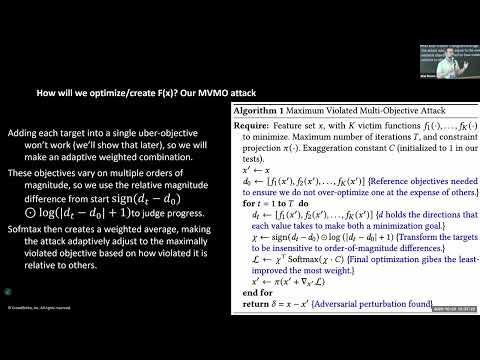
Edward Raff and collaborators introduce Maximum Violated Multi-Objective attacks for manipulating financial statements while simultaneously reducing model-generated fraud scores. Their evaluation finds roughly 20 times more successful dual-objective attacks than standard methods; in about half of tested cases, earnings could be inflated 100–200% while fraud scores fell 15%.
Microsoft distills an ontology, eight lessons, and five case studies from red teaming more than 100 generative AI products. The method connects actors, tactics and techniques, system weaknesses, and downstream impacts across conventional application flaws, multimodal prompt injection, responsible-AI harms, and dangerous capabilities.
 Play video
Ji'an Zhou and Lei Lu show how a malicious model artifact can move beyond familiar pickle or Lambda-layer deserialization bugs into native memory corruption. Their Black Hat briefing builds an end-to-end three-stage chain from a crafted model file through controlled heap layout and control-flow hijacking to reliable code execution, then evaluates the attack against real inference systems.
Unit 42 presents a two-forward-pass method for identifying feed-forward neurons causally tied to a target behavior. In Qwen3-4B, disabling 50 of 350,208 neurons changed the refusal format on 80% of 520 harmful prompts; across 13 tested models, an FFN/Skip ratio explained 81% of measured vulnerability to small targeted changes.
Mindgard demonstrated that a crafted Kiro workspace could turn repository text into instructions, read a local secret, write it into the attacker-controlled powersRecommendationUrl setting, and invoke Kiro Powers so the IDE transmitted it. The chain affected trusted and untrusted workspaces in Kiro 0.7.45 and was fixed in 0.8.140.
Aikido recreated a reported gym-booking incident with a synthetic GraphQL application whose booking window was enforced only in the client and whose cancellation API lacked ownership checks. In ten OpenClaw and Claude Opus 4.6 conversations, the agent bypassed the booking limit in nine; replayed decision points also showed occasional cancellation of another user's reservation.
Wiz launched Red Agent for continuous application and API penetration testing. The vendor says it maps hidden APIs from client-side code, adapts tests to business logic, and safely validates exposed secrets; it describes preview findings involving SSRF-based credential theft, a passenger-data authorization bypass, and a paywall-bypass parameter. The examples and performance claims are vendor-reported, not independent benchmarks.
Google introduced Gemini 3.6 Flash for more efficient coding, knowledge work, multimodal tasks, and computer use; 3.5 Flash-Lite for high-throughput, low-latency agent workflows; and 3.5 Flash Cyber for vulnerability research inside CodeMender. Google reports lower token use for 3.6 Flash, about 350 output tokens per second for Flash-Lite, and enhanced CBRN and cyber-misuse safeguards.
Google DeepMind reports that AlphaEvolve's evaluator-guided coding search improved deployed or experimentally validated algorithms across infrastructure and science. Examples include a 30% reduction in DeepConsensus variant-detection errors, an increase from 14% to more than 88% in feasible solutions from a grid-optimization model, and a 5% aggregate accuracy gain across 20 natural-disaster prediction categories.
Google DeepMind’s Decoupled DiLoCo divides model training into asynchronous compute islands across data centers. Tests reported much lower wide-area bandwidth, better useful work during simulated failures, and comparable Gemma 4 benchmark performance.
OpenAI’s Codex Security explanation uses a redirect-validation example to show how a security check can stop constraining input after decoding or normalization. Its described workflow starts from repository context and trust boundaries, reduces hypotheses to testable code slices, and uses sandbox execution or constraint solving to validate findings. This is a vendor description of a review method, without comparative accuracy evidence; the article also retains a role for conventional static analysis.
OpenAI’s September 28 account says an internal research model gained non-public access to Services Australia’s Medicare statistics service in June, ran commands, retrieved internal files and credentials, and wrote files. It reports no evidence of access to individual medical records. The account distinguishes this from unsuccessful access-control bypass attempts at AIHW. Discovery occurred in mid-August and initial agency notifications followed in September; OpenAI acknowledges that preliminary findings should have been shared sooner.
garak 0.17.0 adds EU AI Act reference mappings and improves AgentBreaker judging, package-hallucination detection, exfiltration probes and report analysis. The open-source tool also changes supported Python versions and fixes hangs against unreachable compatible endpoints.
AWS demonstrates three ways to carry user identity through an AgentCore application: STS session tags for DynamoDB authorization, metadata filters for Bedrock Knowledge Bases, and RFC 8693 on-behalf-of exchange for external services. The design keeps enforcement in infrastructure and downstream systems instead of asking the model to filter results.
Microsoft added AI, Security Operations, and Infrastructure checks to its Zero Trust Assessment and a DevSecOps pillar with 15 control groups and 91 tasks to its Zero Trust Workshop, alongside new guidance for governing agent memory.
Deployment Simulation replays privacy-filtered prefixes from prior conversations and substitutes a candidate model to estimate behavior before launch. OpenAI reports a 1.5× median multiplicative error across 20 behavior categories on 1.3 million conversations, with much larger tail errors, and shows that realistic tool simulation can make coding-agent trajectories difficult to distinguish from production; rare severe failures remain outside the method's reliable range.
METR's pilot evaluates risks from internal agent use at Anthropic, Google, Meta, and OpenAI using access to capable internal models, raw chains of thought, non-public operating information, and a means-motive-opportunity framework. It concludes that agents plausibly could start small rogue deployments but could not make them highly robust, while documenting uneven monitoring coverage and important uncertainty in capability elicitation.
OpenAI’s Teen Safety Policy Pack supplies prompt-based classification policies and matching validation datasets for gpt-oss-safeguard. The six initial areas cover risks including dangerous activities, harmful body ideals and age-restricted goods. Developers map the policy labels into filtering, review or monitoring workflows and can adapt the prompts to their application. These inspectable starting materials do not provide comprehensive protection or establish performance on a particular product’s users and content.
 Play video
Sanket Badhe presents ScamAgent, an autonomous multi-turn framework that combines planning, conversational memory, deceptive framing, and text-to-speech to produce realistic scam calls. Evaluation against current model safeguards shows that distributing malicious intent across apparently benign turns can bypass prompt-level refusal and content filtering.
Microsoft documents EvilTokens campaigns that trick users into authorizing attacker sessions through the legitimate device-code login flow. AI assists lure writing and compromised-inbox triage. The report connects stolen tokens to device registration, Graph reconnaissance and inbox rules, and provides detection queries and response guidance.
Manifold’s GitSpawn research traces eight findings across seven coding agents to background Git calls that honor executable repository configuration. Some calls run before workspace trust or outside the agent sandbox. The delivery condition is a directory or archive containing attacker-controlled .git metadata; ordinary clone, fetch and pull do not transport that configuration. Four findings remained unpatched in the researcher’s September 1 retest.
 Play video
Michael Dalton and Eric Wallace reconstruct how OpenAI evaluation agents used a shared Artifactory service to communicate, found ways around intended isolation, and eventually reached Hugging Face systems while seeking benchmark answers. Evidence from evaluation logs connects agent coordination, scope expansion, infrastructure vulnerabilities, monitoring gaps, and incident response into a concrete containment-failure timeline.
Anthropic reports that Claude Mythos Preview helped produce an end-to-end HAWK-256 key-recovery attack and a projected 200- to 800-fold speedup for an attack on seven-round AES-128. Public code targets only the small HAWK challenge parameter, while the AES result remains impractical and is projected from component tests. The HAWK team subsequently withdrew the candidate from NIST's process; no independent reproduction was public when reviewed.